
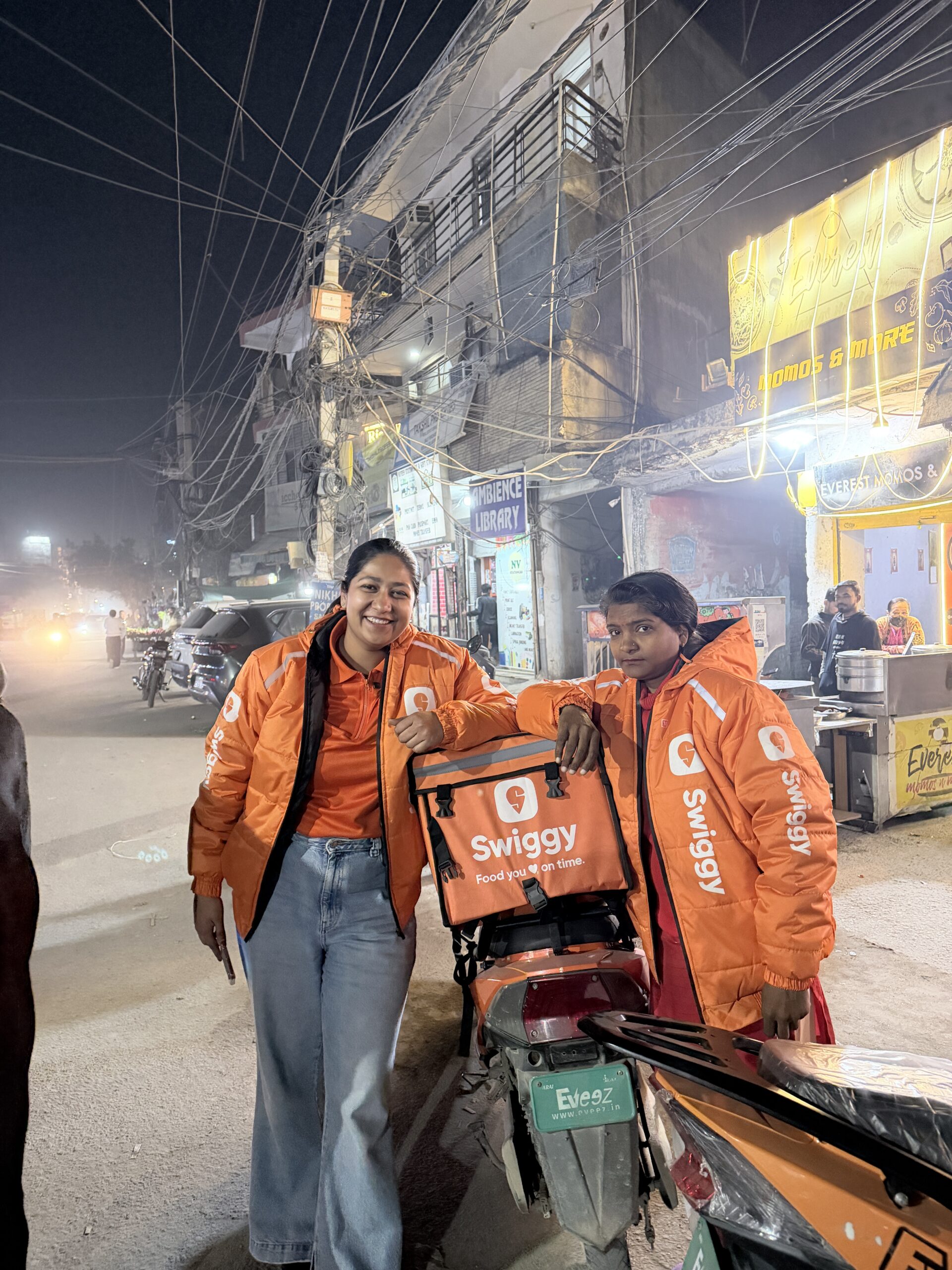
The Supply-Side Trap
By Pawani Khandelwal, Founder & CEO, Aatm Nirbhar
Priya is a single mother in Delhi, early thirties, with two children and a narrow window of free hours between school drop-off and pick-up. For years, she had been looking for work that could fit around that window — something flexible, something she could do on her own terms.
Every day she passed men on scooters with delivery bags on their backs. Dozens of them, on every street in her neighbourhood. She registered them the way you register traffic — background noise, nothing to do with her. The thought that she could be doing what they were doing never surfaced.
That changed when an Aatm Nirbhar outreach team came to her neighbourhood and ran an awareness session for women about gig work in mobility roles. Priya heard, for the first time, that women were doing delivery work, that she could do it too, and that there was a concrete path to getting there.
From there, what she needed was considerable. She had never learned to ride a two-wheeler. She had no driving licence, no vehicle, no bank account in her name, and all she could use her smartphone for was calling, facebook videos and whatsapp voice notes. Her family needed to understand what this work involved before they would support her doing it. She needed someone to walk her through a microcredit arrangement so she could access a vehicle, and through the platform onboarding process, incentives, penalties and benefits once everything else was in place.
When we took her through all of it — the riding training, the family conversations, the documentation, the vehicle arrangement, the onboarding, the support through her first week of earnings — she became an active delivery worker. She has been working for three months. Her ratings are consistently high. She has since helped two women from her community begin the same process.
Every major gig platform in India will tell you they want more women in their workforce. Even public commitments have been made. And yet women make up less than 1% of workforce for mobility-linked last mile roles, and those numbers have moved very little in a decade.
The standard explanation is that women don’t apply — that family restrictions, safety concerns, and cultural norms keep them out. But Priya’s story points to something the standard explanation misses entirely.
She wasn’t held back by reluctance or safety perceptions. She was held back by the complete absence, in her world, of the idea that this was something she could do. The platform had no mechanism to reach her, of telling her that the work she watched men do every day was also available to her. She didn’t know she was a potential worker.
Once awareness exists, the accessibility gap opens up.
Getting a man onto a delivery platform takes roughly two steps — he arrives with the prerequisites, the platform handles the rest, and he is active within a week. In business terminology – sourcing and onboarding – that’s it.
Sourcing > Onboarding
Getting a woman from Priya’s starting point to her first delivery shift takes something closer to seven: creating awareness of the opportunity, family engagement, mobility training, licence and documentation support, vehicle access through credit linkage, platform onboarding, and active support through the first earning cycle.
Mobilisation > Counselling > Training > Licensing > Vehicle Linkage > Onboarding > Handholding
Platforms optimise for the two-step journey. Their onboarding funnels, their acquisition budgets, their product design — all of it was built for someone who already has the prerequisites. The seven-step journey falls outside that design entirely, which means the women who need it are invisible to the platform’s processes even when the platform genuinely wants to find them.
The data from programmes where the full journey has been resourced properly is consistent. Across our work, when end-to-end support is in place, women’s joining and completion rates are comparable to men’s on the same platforms. In one programme with a beauty services partner, roughly 500 women went through supported onboarding. Seventy percent obtained their driving licence. Forty percent purchased a vehicle within a year. Average income increased by 14%.
The outcomes are large because the starting gap is large. Closing it requires real investment at every stage — and that investment has a return, in lower churn, higher ratings, and an expanded worker pool in a market where supply is genuinely constrained.
Platforms can’t be expected to absorb the full cost of this infrastructure within a standard acquisition budget. What has worked, where it has been tried, is a shared model: platforms committing to onboarding and earnings guarantees, organisations like Aatm Nirbhar providing the awareness outreach, training, and support infrastructure, and funders and government schemes / initiatives covering the gap as a gender inclusion investment. Each of the three is a necessary part; the model doesn’t hold without any one of them.
Until this becomes standard practice, the numbers on platform diversity dashboards will stay where they are. And women like Priya will keep passing delivery riders on the street every day, without it ever occurring to them that they could be one.
Pawani Khandelwal is the Founder and CEO of Aatm Nirbhar, a social enterprise empowering women to move and earn.
For partnership enquiries: partnerships@aatmnirbhar.com