
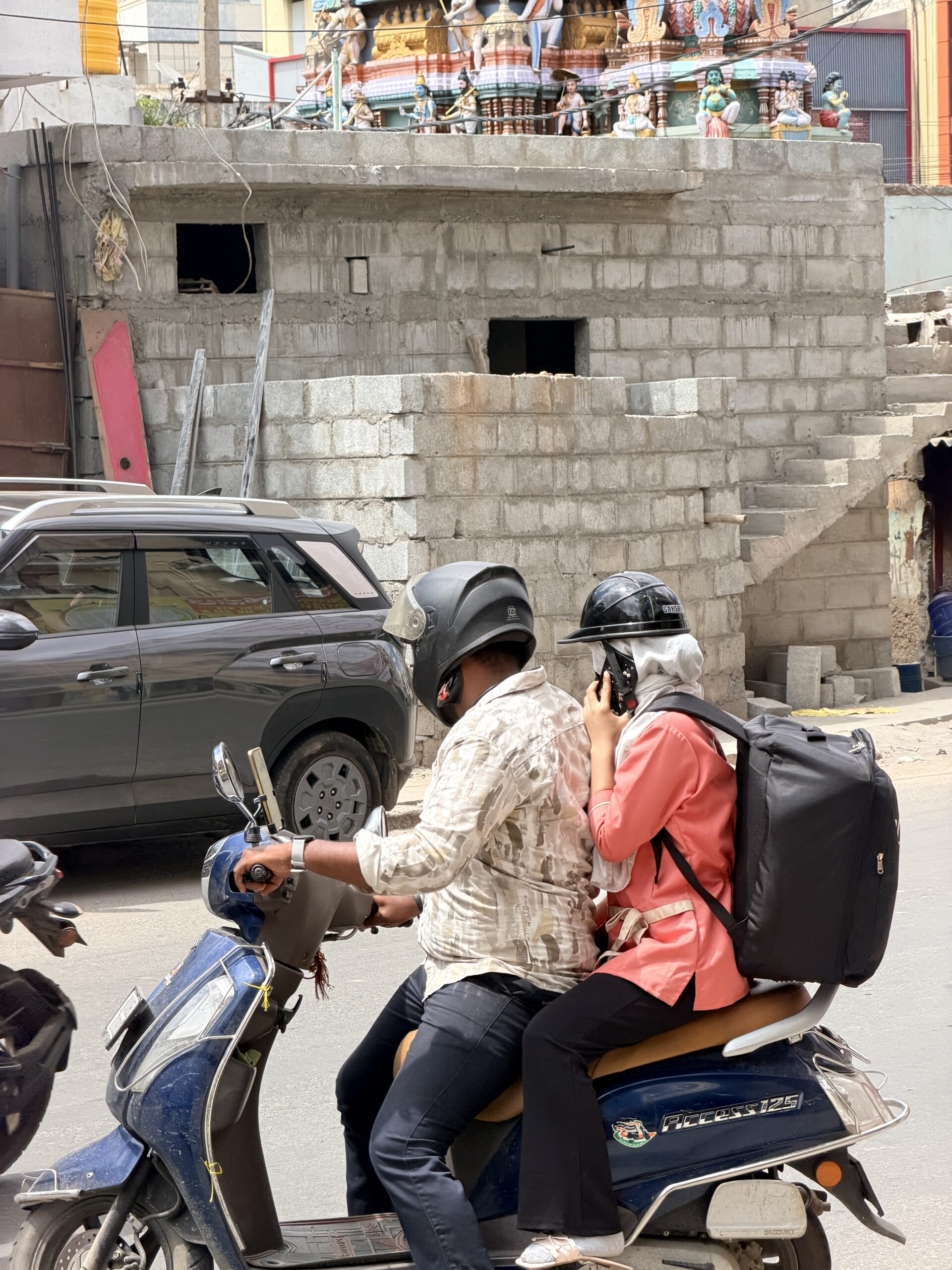
How on-demand home services platforms are running a parallel logistics operation to move their women workers — and why it is a problem they did not plan for.
Published by Aatm Nirbhar Learning Pvt. Ltd. | aatmnirbhar.com
The instant house help category is the latest on-demand battleground that startups across India are racing to own. And across every city these platforms serve, the same scene repeats itself every day.: women in uniforms arriving at homes on scooters and bikes — not as riders, but as passengers.
Some platforms have built hub-based models to solve the supply problem. Women professionals are stationed at centralised hubs positioned across demand zones — the same logic as dark stores in quick commerce. When a booking comes in, the nearest hub dispatches. A female househelp on a two-wheeler, sitting behind a male rider.
These platforms train their women professionals to clean meticulously, to iron all creases out perfectly, to reach every stain in every corner. But the one skill that determines whether she can travel independently to fulfil that job — riding a two-wheeler — is not part of the programme.
So a male rider fills the gap.
How the Model Works
Some platforms operate a hub-based logistics model. Women professionals are stationed at centralised hubs across the city. When a booking comes in, a male rider picks the woman up from the hub, drops her to the service location, and returns to collect her when the job is done.
This model solves a real problem: it gets non-riding women to jobs quickly and reliably enough to deliver on the promise of 10-minute availability. It works. But it comes at a cost that compounds as the platform scales.
These platforms did not set out to build a logistics company. But to activate women who cannot ride, that is effectively what they have done — running a fleet of male riders alongside their core home services operation.
What It Costs
For platforms running the hub-and-rider model, the costs are explicit and on the books. Consider an illustrative estimate for a platform operating at moderate scale:
| Assumption | Illustrative Figure |
| Women professionals on platform | 5,000 |
| Non-riding women professionals (60%) | 3,000 |
| Average jobs per professional per day | 5–6 |
| Total trips requiring transport daily | 15,000–18,000 |
| Riders required | 600–900 |
| Rider cost per day (salary, fuel, vehicle wear) | ₹800–₹1,200 |
| Total daily rider cost | ₹4.8L – ₹10.8L |
| Annual rider logistics cost | ₹17.5Cr – ₹39.4Cr |
This is before accounting for hub rental costs, hub staff, rider management overhead, and the coordination friction of matching riders to bookings in real time.
But cost is not even the sharpest problem.
More Than Just a Cost Issue
The male rider dependency sits on top of a supply crisis that platforms across food delivery, e-commerce, and ride-hailing have been dealing with increasingly.
Riders have high attrition, high acquisition cost, and low platform stickiness. Every gig platform is competing for the same shrinking pool of available riders — and losing many of them within weeks of onboarding.
For home services platforms, this compounds the operational challenge: they need male riders to move their own workforce. When rider supply tightens, service capacity tightens with it — even if the women professionals are available and ready to work.
What Women’s Independent Mobility Unlocks
- The fastest lever on unit economics
A woman who rides can get from the hub to the job herself. She is no longer cargo but rather an active agent moving through the system. The 10-minute promise becomes something the platform can deliver without a parallel rider operation — and without the rider salaries, fuel costs, and coordination overhead that come with it. Every woman who becomes independently mobile significantly improves unit economics, increasing the platform’s contribution margin.
- Earnings improve — for the woman and the platform
Women who are independently mobile complete more services and therefore earn more — for themselves and for the platform. They spend less on commuting, maintain better ratings, and stay on platform longer. A woman who depends on someone else’s schedule to get to work is one unavailable ride away from attrition.
- Supply becomes truly on-demand
A woman who rides does not need a hub to start her day. She leaves from home, travels directly to the job, and arrives without any staging infrastructure in between. Supply is no longer anchored to fixed hub locations — it is distributed across the city wherever women live. New demand zones, surge areas, underserved neighbourhoods — supply can follow demand in real time, without waiting for a hub to exist first. Hub dependency drops. Operating costs drop with it.
- Supply scales without a ceiling
Today, a platform’s supply capacity is a function of its hub footprint. Every new hub is a capital decision — location scouting, lease, staff, rider fleet. Growth is linear, expensive, and slow. A woman who rides breaks this model entirely. Supply becomes a function of how many women can ride — and that number can grow as fast as you can enable it. For the first time, a platform’s supply infrastructure scales the way its demand does: digitally, continuously, without a fixed cost for every unit of new capacity added.
What the Data Shows
Aatm Nirbhar has enabled mobility for over 20,000 women across 20+ cities in 9 states. An independently validated RCT (co-authored with a UC Berkeley researcher) documents what changes when women gain independent mobility:
14% Income Growth — within 3 months
40% Reduction in Travel Costs — per woman, post-mobility
63% Vehicle Ownership Uptake — post-programme
How Aatm Nirbhar Works With Platforms
Aatm Nirbhar is a mobility enablement platform. We work with partners to make their existing women workforce independently mobile — removing the transport dependency that sits underneath no-shows, attrition, and operational complexity.
What we bring:
- A pan-India network of Scooty Didis — female mobility enablers embedded in the communities where platform workers live
- Partnerships with major financial institutions to unlock vehicle ownership for women
- Partnerships with major EV rental operators across India
- Partnerships with OEMs and dealerships
- A tech-enabled platform for full transparency on monitoring, evaluation, and impact
- A track record of working with Urban Company, Swiggy, Piramal Foundation, and Pratham Foundation — with 20,000+ women enabled
To explore a partnership: partnerships@aatmnirbhar.com | +91 9354123761 | www.aatmnirbhar.com